Sermon at the Resurrection Mass of Father Cody Unterseher

All of us go down to the dust; yet even at the grave we make our song:

Alleluia, alleluia, alleluia!

In the name of God: Father, Son, and Holy Spirit. Amen.

The disciples were full of questions about God. Said the master, “God is the unknown and the unknowable. Every statement about Him, every answer to your questions, is a distortion of the truth.” The disciples were bewildered. “Then why do you speak of Him at all?” “Why does the bird sing?” said the master.[1]

On Thursday morning, as we gathered here at Christ Church to begin the planning for today’s Mass of the Resurrection, Cody’s mother Carla handed me a copy of this story, “The Song of the Bird,” by the Jesuit priest Anthony de Mello. Perhaps, she said to me, it might be useful in the preparation of the sermon for the mass, as it was a favorite of Cody’s, one he had shared with several friends and family.

As it turns out, I can think of few stories better to use on such an occasion as today. For Cody lived just as the bird – always singing the Lord’s song, living his life as a sacrifice of praise and thanksgiving to the Triune God whom he loved, and who so deeply loves him. It was simply who he was. He wholly exulted in his Lord even when God seemed most foreign, most unknown, most unknowable. Cody, like the bird, could not keep from singing, even on days like today. Every fiber of his being rejoiced in God his savior, every moment was an act of worship. All of us, who have gathered here today to celebrate his life and ministry among us, know this of our dear friend and brother in Christ Jesus.

Ever since Cody so suddenly fell ill, and especially since he moved from the Church Militant to the Church Triumphant this Wednesday, every fiber of my being has told me that this shouldn’t be happening. That we shouldn’t be here. That thirty-six year olds are not supposed to have aneurysms. That someone as good, and holy, and loving, and intelligent as Cody is not supposed to leave us in his prime, with so much to offer the church, to the academy, and to the world. Even as I stand in this pulpit now, and see my friend lying here, I simply want someone to pinch me, to wake me up, to end the nightmare of the past few days.

I imagine that Jesus’ disciples must have felt the same way after Good Friday, as they looked back on their final few days with their Lord. They must have wanted their nightmare to end, as they sat in fear on Friday evening, pondering over what Jesus had told them only the night before – those same words we hear in today’s Gospel:

Do not let your hearts be troubled. Believe in God, believe also in me… I go and prepare a place for you, I will come again and will take you to myself, so that where I am, there you may be also.[2]

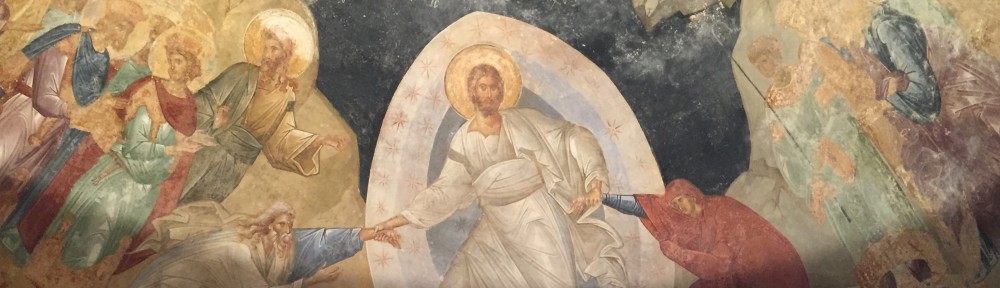
On the day that Jesus died, the disciples were left with only their grief, their great sense of loss and pain, their confusion at how their Lord could tell them, in a time like this, to “not let their hearts be troubled.” After all, they had seen that Jesus had gone not to a great mansion, or to a palace, or to triumph, but to the cross. To death. To the grave. Back to the very dust of the earth. Yet we know what the disciples could not have known on that fateful Friday – that the glories of Easter were only just beyond the horizon. That the Risen Lord would rise from the grave, and, destroying death, would make the whole creation new. And that the risen Lord sent those same disciples who had sat in fear on Friday night out in to the world only days later – commanding them to go and make disciples of all nations, baptizing them in the name of the Father and of the Son and of the Holy Spirit.[3]

Paul spoke to this great mystery in his Letter to the Romans: “Do you not know,” he asks, “that all of us who have been baptized into Christ Jesus were baptized into his death? Therefore we have been buried with him by baptism into death, so that, just as Christ was raised from the dead by the glory of the Father, so we too might walk in newness of life. For if we have been united with him in a death like his, we will certainly be united with him in a resurrection like his… If we have died with Christ, we will also live with him.”[4]

It is this great mystery that we celebrate today – the sure and certain knowledge that Cody, who joyfully lived and sang knowing that he was sealed by the Holy Spirit in Baptism and marked as Christ’s own forever – that he was baptized into Christ’s death and is forever united with him in his resurrection. We celebrate the knowledge that neither death, nor life, nor angels, nor rulers, nor things present, nor things to come, nor powers, nor height, nor depth, nor anything else in all creation, will be able to separate him from the love of God in Christ Jesus our Lord.[5]

We know that despite the pain and sadness of this day, as we commend our pastor, teacher, son, and friend Cody to God’s gracious care, that this is not Cody’s Good Friday moment, for as a Christian, baptized into Jesus’ body, Cody was not a Good Friday person. Cody is a resurrection person. Death cannot separate him from God’s love, because he at his baptism, he was already raised with Christ.

Indeed, nothing could ever possibly separate us from the love of God, for as Christians, we believe that even heaven itself is not God’s final word. We look forward to the great feast that Isaiah foretold, in which heaven and earth are joined, when death is swallowed up forever, and when the whole creation is made new. We know that even as today we commend our dear brother Cody to the dust of the earth, that our Lord’s victory over death assures that this very same dust will be that upon which a new and more glorious creation is being built. Even now… Even today.

My very first encounter with Cody was when I was a prospective student, looking to enter General Seminary in 2008. I visited in the spring, towards the end of the semester, and attended the noonday mass at which Cody had been assigned to preach. I remember it vividly, because in his sermon, without hesitation or reservation, Cody sang:

My life flows on in endless song;
Above earth’s lamentation
I hear the sweet though far off hymn
That hails a new creation:
Through all the tumult and the strife
I hear the music ringing;
It finds an echo in my soul—
How can I keep from singing?

What though my joys and comforts die?
The Lord my Savior liveth;
What though the darkness gather round!
Songs in the night He giveth:
No storm can shake my inmost calm
While to that refuge clinging;
Since Christ is Lord of Heav’n and earth,
How can I keep from singing?

I lift mine eyes; the cloud grows thin;
I see the blue above it;
And day by day this pathway smoothes
Since first I learned to love it:
The peace of Christ makes fresh my heart,
A fountain ever springing:
All things are mine since I am His—
How can I keep from singing?[6]

AMEN.


[1] Anthony de Mello, S.J. “The Song of the Bird”

[2] John 14:1, 3

[3] Matthew 28:19

[4] Romans 6:3-5, 8

[5] Romans 8:38-39

[6] “How Can I Keep from Singing,” Robert Wadsworth Lowry.

Ordination and the Time Thereafter…

It has become standard in the letters of agreement in the Diocese of Long Island for parish clergy to receive the weeks after Christmas and Easter off. I can’t even begin to say how grateful I am for this, especially given how momentous this December has been: in the span of two weeks, I was ordained as a priest, observed the final two Sundays of Advent, had our Transitioning Clergy meeting in Garden City (where I was asked to celebrate the Eucharist), the regular assortment of holiday parties and festivities, and finally, celebrated and preached at my first Christmas Eve Midnight Mass and Christmas Day mass. It has been an incredibly busy time, and I’m just now starting to have a chance to catch my breath, to reflect, to rest.

"Therefore, Father, through Jesus Christ your Son, give your Holy Spirit to David; fill him with grace and power, and make him a priest in your Church."

One of the questions I was asked most often after my priesting - by parishioners, clergy colleagues, family and friends alike - was “do you feel any different?” I’ve struggled to answer that question on so many different levels. If the question was “are you any different?” the answer would be simple - yes. I’m catholic enough to believe that there is an ontological change at ordination; ordination is not simply the church’s recognition of a pre-existing reality, or an installation into an office: ordination confers grace. That’s an easy question to answer from my perspective. But “do you feel any different?” - well - yes and no. I was struck at my first celebration of the mass on Advent III how often I felt like I was “play-acting.” At a core level, I know I wasn’t - but it was so very strange when, after 26 years of watching other people at the altar celebrating the mass using these same prayers, suddenly, it was me. I grew up as an Episcopalian, and have known nothing but the 1979 Book of Common Prayer, so the words I was praying were abundantly familiar. But for 26 years, they had come from some other person’s lips. Not mine. Perhaps the most astounding moment of my first mass, at least to my thinking, was when I elevated the chalice at the per ipsum at the end of the Eucharistic Prayer, and saw my own face reflected in the silver. It was sort of like having a loud voice shout at me, “Ready or not, you’re a priest now! Hope you like what you see…”

In time, I imagine celebrating the mass will turn back into prayer for me, as it was before I was ordained, either as a deacon or as a priest. It doesn’t feel like it yet. Perhaps because the smell of chrism is still quite fresh on my palms, and I’m very, very much new to this gig. It’s hard when the normal patterns of prayer are disrupted, when any big event fundamentally changes the way you relate to other people and to God. In time, you live into that new reality - but it does take some time. Falling down a few times as you get used to the new terrain. And being willing to get up, fall down a few more times, until the ground that once seemed so unsteady becomes the new normal.

So when did I first begin to actually breathe in the new reality - to not just be different, but feel different? Exactly one week later. One week later, I made the trek from my far corner of southwest Brooklyn to Larchmont, New York, to participate in a friend’s ordination to the priesthood. Interestingly enough, priesthood became real to me when I added my hands to the “holy huddle” in making someone else a priest. Not because I was no longer the “newest priest in the Church.” That common introduction of new clergy fades very rapidly, and at least to me, doesn’t mean much. Perhaps it was because in laying my hands on another person at their ordination, it was among the very first times I had was able to very clearly, visibly, and tangibly be a part of someone else living out their own call to discipleship. He went under the hands of the bishop, the college of presbyters lent our hands to the pile - and he came out a priest. And while I imagine he didn’t feel any different - at that point, I did. Because I could see where I played a part - a teeny-weeny, small, peripheral part - but a part nonetheless - in making a priest. A disciple. Just like Jesus told us to.

My job is awesome.

Reflections on a Baptism.

On Saturday, I baptized “my” first baby since being ordained. It was an overwhelmingly joyful moment - one I personally very much needed, since I have already done six separate funerals or interments in the five months since I arrived at Saint Johns.

I repeated a practice here that was common in the church where I was raised: inviting all the young children present to gather around the font to watch. It was so thrilling to me to watch them crowd around the edges, each trying to get a closer look. I couldn’t help but remember doing the same as a child - standing on tip-toes trying to get a closer view - that memory very nearly made me lose my own composure.

But perhaps the thing that most struck me is that there is no “neat” way to do a baptism. You get wet pouring water from the pitcher into the font; you get wet as the baby squirms and knocks the shell out of your hand; you get wet, when, after the third and final covering with water, you raise the child back upright and the water streams off of its head. But, even if there is a neat way to baptize, I would argue strenuously that we shouldn’t attempt it.

Baptism is prodigal in its “messiness” - water gets everywhere. Things get wet, and there’s utterly nothing you can do about it. But, of course, the grace offered to us in the sacrament of Baptism is utterly prodigal, too - an unmerited and undeserved adoption as God’s children, a full knitting into Christ’s body the church, and heirs of the kingdom of God. There’s no clean, neat way to describe what happens - because the whole scenario is messy. We get baptized, and we get fundamentally, radically changed. And once that water covers us, there’s no going back. A friend once reminded me that there are two words affiliated with washing in the New Testament - bapto (I wash), and baptizo (I baptize). Bapto implies a simple dipping in water, much like taking a short bath, or washing one’s hands. But baptizo, baptism, on the other hand - denotes an fundamental change. It’s the difference between a cucumber and a pickle - you can dip a cucumber in some water, and it’s still a cucumber. But once a solution changes it into a pickle, it’s never going to be a cucumber again. Things are messy, and things change.

I loved the messiness of the baptism on Saturday. I may have even tried to be a bit messier than is prudent - raising the pitcher a bit higher so the kids around font would get a bit of the kickback as the water hit the font; using larger scoops of water than I needed; making no efforts to avoid getting water on myself or anything else.

But that’s just how baptism goes. Prodigal in its giving of grace. Fundamental in the way it changes things. And messy enough that once that water hits you, you know there’s no going back.