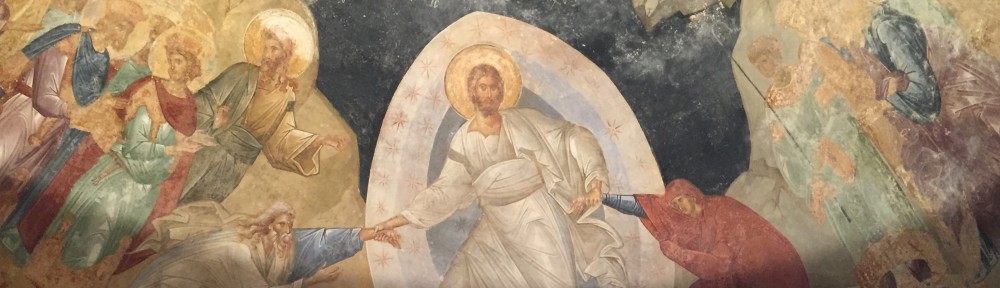
Good Friday, 2014

When we make our way to the foot of the cross, to that lonely hill outside of Jerusalem, our sense and reason often fail. This holy and sacred day always inspires deep questions among those of us who follow after Jesus. Foremost among them is “why?” Why did the worst elements of our humanity drive Jesus to the shameful death of a criminal? Why would a loving God have his Son die in order to save humanity? Good Friday is a day that seems to inspire many, many questions, but few answers. The cross is, it seems, truly scandal.

We face two dueling temptations every Good Friday, and we have faced them over and over again throughout the centuries. The first temptation is to lash out in anger and revenge, seeking out those who we believe to be responsible for Jesus’ death on the cross. But to do so is always to set up a straw man to receive our own guilt, rather than face the fickleness and brokenness that lies in the depths of our own humanity. And, as often happened throughout history and still continues to this day, such an inclination only creates more hatred and more violence. This is not where we are called to dwell on this day. And this inclination misses a larger truth: that the story of the cross is not simply about the process that led to Jesus’ death – but about the glory of God.

The second temptation is to impute all guilt to ourselves, and plumb the depth of our own souls in guilt. We recall our own sinfulness, our own brokenness, our own violence. To look inward is a far more noble response than to lash out in violence against our neighbors. And to be sure, as humans – imperfect, and sinful – we can always see outright signs – of the fear, hatred, and anger that we hear echoed in John’s passion today as Jesus moves toward the cross. But this, too, is not where we are called to dwell on this day, for the story of the cross, is not simply about the process that led to Jesus’ death – but the Glory of God.

The cross is the Glory of God, and Jesus’ ultimate glorification. “The message about the cross,” Paul writes, “is foolishness to those who are perishing, but to us who are being saved it is the power of God.” The cross is not Jesus’ shame, but his glory. The cross is not Jesus’ weakness, but his power. The cross is not Jesus’ defeat, but his victory. In John’s passion, Jesus is fully in control as he moves toward the cross. In the garden, Jesus tells Peter to put away his sword and orders Peter to allow him be taken away by soldiers. He stands in silence in front of Pilate knowing that death lay before him. And even from the cross itself, Jesus’ life does not end with a loud cry, but in three quiet words: “It is finished.”

With those last words, we hear a Jesus has truly seen all of our humanity. He has seen humanity its best: the love of an official for his sick son who begs for Jesus to heal him, his disciples who have tried to follow after him as best they could, of Mary and Martha weeping at the loss of their brother Lazarus. And he has seen humanity at its worst on his way to the cross: our rage, spite, jealousy, mistrust, and fear. And finally, at the cross, Jesus, the Word made Flesh, encounters that last defining element of our humanity – our mortality. And in the face of death, he radiates love. As he is lifted high on the cross, Jesus draws all people to himself.

This truly is the foolishness and the power of God, that Jesus, the word made flesh, should face what the theologian Frederick Buechner called the ‘magnificent defeat’ – where Jesus’ wounds are “the proud insignia of the defeat which is victory, the magnificent defeat of the human soul at the hands of God.” It is the foolishness and the power of God that Jesus, the Word Incarnate, should meet us here as we are, even though were we are is already place of death and shame, a place where, if we would have our way, we would never allow God to come and meet us. Yet God comes there anyway. At the cross, the place where we think we are sure to keep God far away from us, God shows true glory, meets us, and raises us to a new life of grace.

And so as we look to the cross on this day, even as we see death, we receive the stuff life itself. Even as we see our own hatred and evil, we see the love of God expressed in its fullest measure. We look at the cross, and we see God incarnate, God fully with us, God fully for us. And our response can be simply to adore. Here we glory in the Cross, by which joy has come into the world. We sit, we adore, in wonder and in awe of the embrace of Jesus’ arms of love, stretched out for our lives, and for the life of the world.

Maundy Thursday, 2014

And during supper Jesus got up from the table, took off his outer robe, and tied a towel around himself. Then he poured water into a basin and began to wash the disciples’ feet and to wipe them with the towel that was tied around him. He came to Simon Peter, who said to him, “Lord, are you going to wash my feet?” Jesus answered, “You do not know now what I am doing, but later you will understand.” Peter said to him, “You will never wash my feet.” Jesus answered, “Unless I wash you, you have no share with me.”

I have often wondered what it must have been like to be Simon Peter, in that Upper Room during dinner. More specifically, I wonder about one specific moment – that pregnant pause right after Jesus has begun to wash his disciples’ feet. I imagine the room as completely silent, save for the sound of the splashing of water, and the cold hard “click” of pottery against the floor. What would it have been like for Peter in that moment?

Peter had been with Jesus since his brother Andrew had told him that he had found the Messiah; when he first met Jesus, the Lord had said he was to be called Cephas – Rock – and that was pretty much that. He followed after Jesus. And then almost immediately, Peter saw so many things he never would have imagined. A paralyzed man was made to walk in Bethesda; and 5000 people were fed from from five barley loaves and two fish. Jesus had walked across the Sea of Galillee to them in the midst of a storm, he had restored the sight of man who was blind from birth, and not a week before, he had spoken to Lazarus and Lazarus rose from the dead.

Having seen all those things – having been with Jesus through all that time – what, then, would have been running through Simon Peter’s mind on this night, in that silence, with only the sound of the splashing of water, and the cold hard “click” of pottery against the floor of the room?

I can’t speak for Peter, but his words make it very clear he was uncomfortable. “You will never wash my feet,” he insists. It feels like the right answer, the holy answer. He has a sense of how great the one in front of him is. It is only in that moment when Jesus looks him and says that “unless I wash you, Peter, you have no share with me” that Peter gives in, overcompensates, even, asking Jesus not just to wash his feet but his head and hands also. When Jesus says to the disciples: “You do not know now what I am doing, but later you will understand,” it must be true - they can’t know what he is doing in that moment. After all, I’m not sure that even here and now, some two thousand years later, we really can comprehend what Jesus was doing in that instant. Do we understand what he is doing? What Jesus is showing us? Even now?

To have one’s feet washed is a profoundly uncomfortable experience. For most of us, it is infinitely easier to wash another person’s feet, to take on the mantle of service and abasement, then it is to sit in the chair and let ourselves be served by another person. And in Peter’s case, this service came from not just any other person, but from Jesus Christ himself. And it begs the question – have we ever truly sat in Peter’s place? Have we allowed ourselves to be in that room, in that chair, in that silence, with Jesus washing our feet?

Jesus tells the disciples the meaning of his actions in the silence of that night in the upper room. He says – both to us and to the disciples - “You call me Teacher and Lord — and you are right, for that is what I am. So if I, your Lord and Teacher, have washed your feet, you also ought to wash one another’s feet. For I have set you an example, that you also should do as I have done to you.” It is this charge and commandment that gives tonight its name – the word Maundy in Maundy Thursday comes from the Latin mandatum – commandment: “I give you a new commandment,” Jesus says, “that you love one another. Just as I have loved you, you also should love one another.” But dare I say it, hearing and receiving this new commandment is often the easy part of the good news on this night. Just as Peter was eager to spring to action and wash Jesus’ feet, as Christians, our first instinct is often to get up and do things – to start another program or another ministry, to pick up another volunteer opportunity, to keep doing more, and more, and more. And in our excitement and enthusiasm – even as we seek to follow after Jesus – we often fail to sit and listen, even as he commanded Peter to do.

First, the gospel says, we must sit. Sit in our disquietude and discomfort as Jesus moves about in that silent room, where the only noise to be heard is the sound of the splashing of water, and the cold hard “click” of pottery against the floor of the room. We must sit, and listen, and obey the Jesus who fed the five thousand, and cured the blind, and raised the dead as he takes on the role of servant – and then, only then – take up the servant’s mantle, wash the feet of others, and reach out our arms in love in the pattern of our Lord. For it is in that moment of discomfort – that moment that we want to shout, “You will never wash my feet!” – it is there, when we look at Jesus, that we see just how powerful a thing it is to be in the presence of the Word made flesh. Because when we look down at Jesus, the servant, we see one fully God and fully human. And it is only then, as we see God taking on an act of service that we will never, ever be able to repay, that we are truly able see in Jesus the faces of our neighbors. It is then, as Jesus washes our feet, that we see the love of God fully expressed for all of humanity. It is in that moment that we understand how love transforms service into something bigger and greater than we ever could imagine. And it is from that moment we are propelled and sent, called to truly be servants of all, as Jesus first was servant of all.

On this night, Jesus Christ calls us to wash one another’s feet, just as he has washed ours. Jesus compels us to reach out our arms in loving service, even as his arms of love were stretched on the hard wood of the cross. Jesus commands us to follow the example that he has set. But first we must simply be still and listen. We must be present and sit in the still and uncomfortable silence of the Upper Room, with only the sound of the splashing of water and the cold hard “click” of pottery against the floor, and come face to face with Jesus, our God who serves.